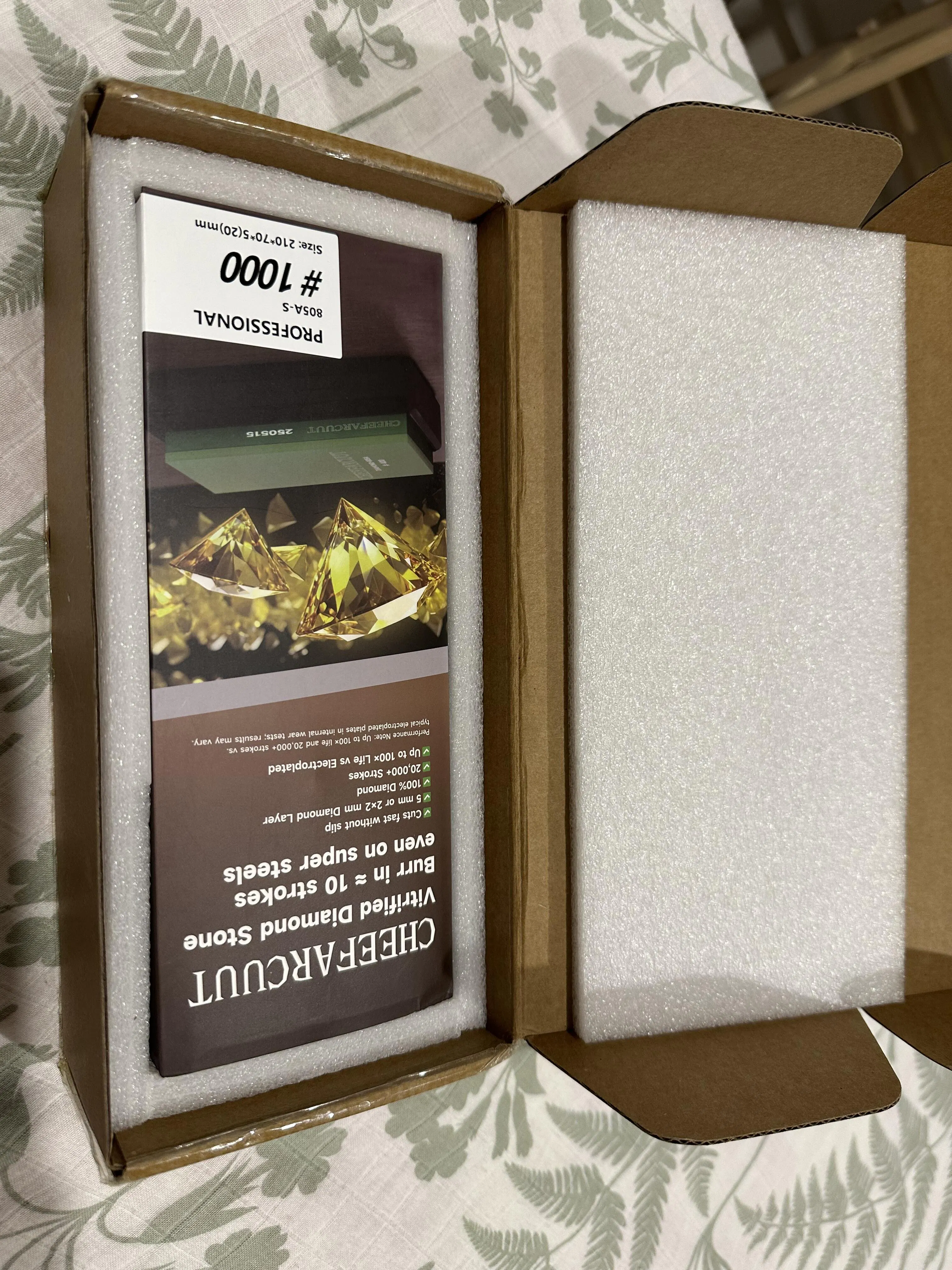
Cheefarcuut-Schleifstein
Verfügbarkeit für Abholungen konnte nicht geladen werden
 Buy on Amazon


⚡ 10 strokes to burr: M390, REX121 under ~2 min
💎 100x longer life vs electroplated: 5mm 100% Vitrified Diamond
🔪 Shreds super steels like nothing: ZDP189, S30V and more
📏 Wide and solid: 8.27 × 2.76 in(210 × 70 mm), stable for more knives
💪 Razor sharp fast and ready for meats and vegetables: #1000 Stone + Leather Strop
🧪 Cleaner finish: uniform scratch
🍳 Home & Professional Kitchens
🏕 Outdoor & EDC Players & Other Professionals
💪 VG10, SSG2, CPM110V, REX121 & Super Steels
🔪 Rapidly repairing chipped edges & Sharp knives and tools
🚫 Not for ceramic/glass knives or mirror polish finishing.
🪵 Come with a holder double as a box
📏 Fits most 210×70 holders.
Knife Compatibility:
🧪 From standard stainless to the hardest super steels.
🔪 Kitchen knives, outdoor knives, EDC folders, tools
💎 100% Monocrystalline Diamond — #1000
🧪 Vitrified bond, non-electroplated
🧱 Rigid, flat slab — 0.2 in (5 mm)
🧰 Aluminum base — 0.6 in (15 mm)
🇭🇰 HK Design | 🇨🇳 Made in China
📏 8.27 × 2.76 ×0.8 in (210 × 70 × 20 mm)
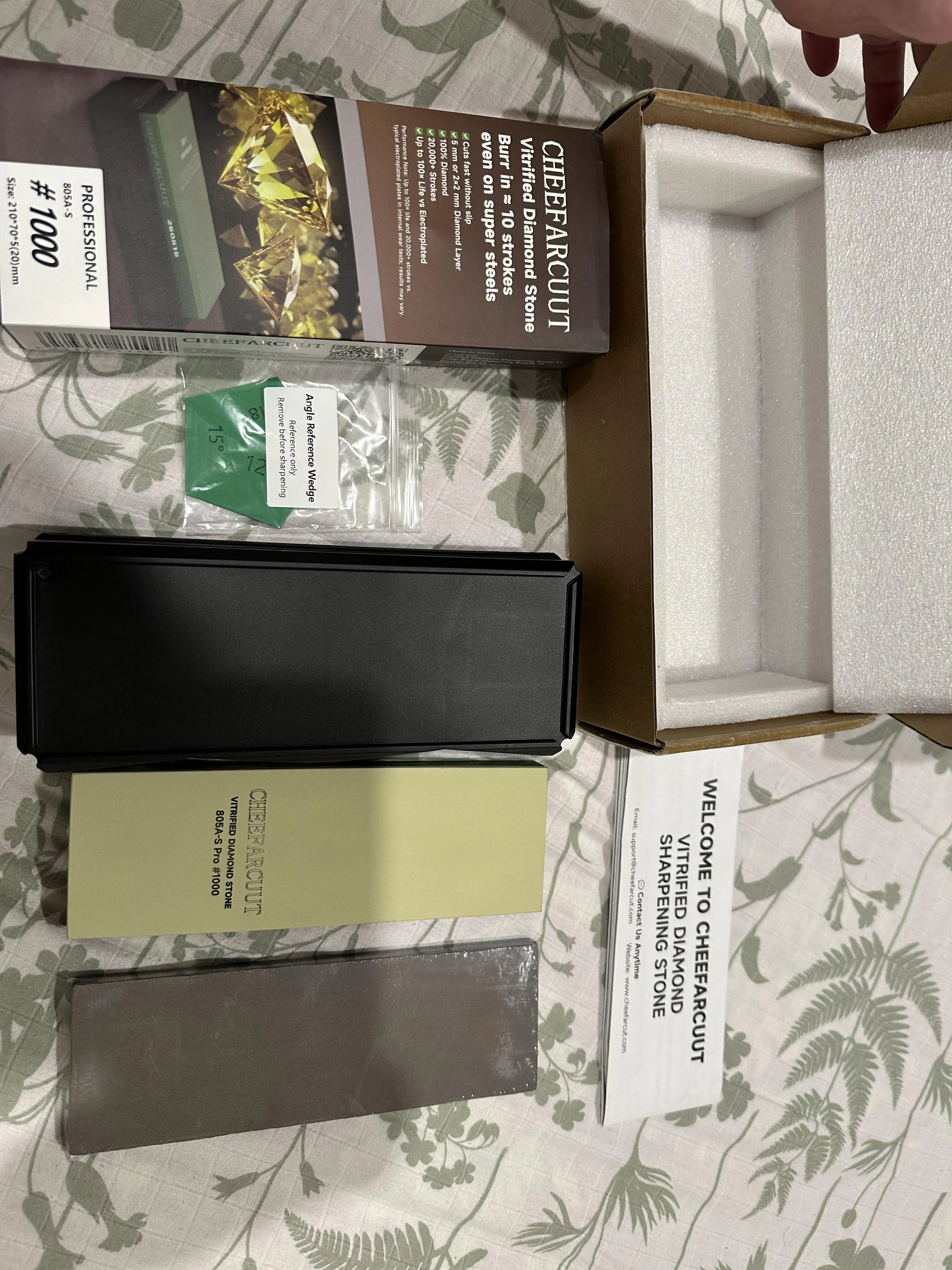
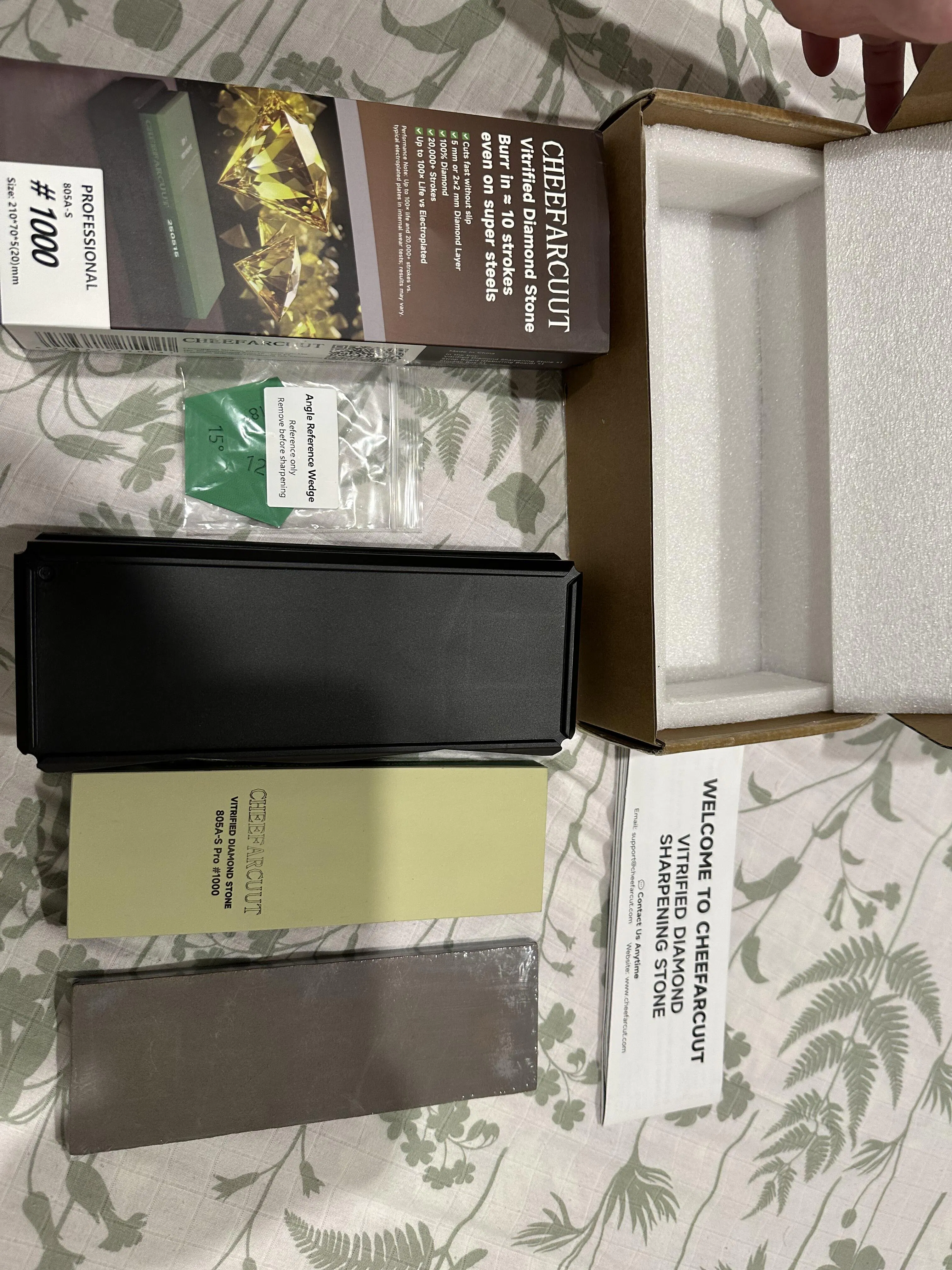
🎁 Ready to use, all essentials included:
💎 1000 Grit Vitrified Diamond Stone
🪵 0.25μm Strop Board (Deburring Board)
📦 Storage box (doubles as base)
📐 Angle Reference Wedge ×1
📘 User Guide
📩 support@cheefarcut.com


Cheefarcuut Pro stones are built around cutting speed, not a slow, glassy waterstone feel. The vitrified bond has strong “grip,” allowing an ultra-high diamond phase (~80%) and continuous exposure of fresh cutting points. The result is a true fast cutter: you can raise a burr in very few passes and get back to a clean working edge quickly.
Use lighter pressure. Because the stone cuts so efficiently, heavy force is unnecessary and can reduce control. Most users get the best scratch uniformity and feedback at ~1/3 the pressure they’d normally use on traditional waterstones (especially when using edge-trailing strokes).
Faster Cuts, Longer Life,
Just the Stone You Need.
Cheefarcuut Diamond,
Cuts the Hardest Steels.
Vitrified
1000 grit
10.2 in(5mm) stone
0.6 in(15mm) aluminum base
8.27 × 2.76 in(210×70) mm footprint

Burr in ~2 min on M390/REX121
Toothy bite, fast stock removal
Feedback proves it

>20,000 strokes, still cuts
No plating, no shed

Controlled Depth
Faster clean-up on #2000+

More control
8.27 × 2.76 in (210 x 70mm) surface
0.6in (15mm) base
No wobble, no slip

One Stone,
Your Entire Arsenal.
Kitchen · Outdoors · Workshop
From chef knives to axes
Yes to ALL Straight edges but no to serrations

From basic stainless to ultra-hard PM steels
Not for ceramic

Pre-loaded Diamond Leather Strop
Deburr micro-burrs in seconds
3-min pre-shift touch-ups

Which Stone Is Right For Me
The following grit chart is what Cheefarcut has in current development. The following grits are available for current and immediate purchase and order fulfillment (200/400/1000 pro & 400/1000 double sided). All other grits are scheduled to be released within 30 days.
| SKU | Thickness (A/O) | Grit | Notes | Application |
|---|---|---|---|---|
| Home-400/1000 | 4/11 mm (2/side) | #400/1000 | Double-sided |
Side #400: heavy touch-ups, chip control, fast bevel set on stainless & PM steels. Side #1000: quick daily sharpening; durable toothy work edge for chef/santoku/petty/EDC. |
| Home-2000/4000 | 4/11 mm (2/side) | #2000/4000 | Double-sided |
Side #2000: fine sharpening & clean deburr; lower friction for smooth push-cuts. Side #4000: pre-polish/finish for glide cuts and plating; not for bone work. |
| Home-3000/5000 | 4/11 mm (2/side) | #3000/5000 | Double-sided |
Side #3000: pre-polish with slight bite—great for sujihiki/gyuto when presentation matters. Side #5000: finishing; remove residual burr and enable glide cuts; presentation grade. |
| Pro-200 | 5/20 mm | #200 | Single-sided | Heavy repair: rapid chip removal and bevel reprofile on severely dull edges; resets geometry fast (not a working finish). |
| Pro-400 | 5/20 mm | #400 | Single-sided | Bevel set & fast burr; aggressive stock removal; leaves coarse tooth for boxes/rope/hard skins; ideal pre-step to #600/#1000. |
| Pro-600 | 5/20 mm | #600 | Single-sided | EDC tooth: coarse, durable micro-serration that matches the fiber scale of cardboard/rope/wood; quick tune-ups; bridges to #1000. |
| Pro-800 | 5/20 mm | #800 | Single-sided | Refines coarse scratches while keeping a “meaty” bite; raises keenness without losing purchase—excellent for poultry/meat prep. |
| Pro-1000 | 5/20 mm | #1000 | Single-sided | Fast sharpening for most kitchen knives; long-lasting working edge that balances bite and glide; the go-to daily finish. |
| Pro-2000 | 5/20 mm | #2000 | Single-sided | Fine sharpening & pre-finish; clean deburr and reduced cutting friction—ideal for smooth veg/protein cuts. |
| Pro-3000 | 5/20 mm | #3000 | Single-sided | Pre-polish with slight bite; smooth push-cuts and neat plating; great for sujihiki/gyuto and refined EDC edges. |
| Pro-4000 | 5/20 mm | #4000 | Single-sided | Fine pre-finish/finish; tunes bite while maximizing glide for presentation slicing. Prefer #1–2K if a toothier edge is desired. |
| Pro-5000 | 5/20 mm | #5000 | Single-sided | First finisher: remove residual burr and true the apex; glide-cut oriented for sashimi/slicers; avoid for bone contact. |
| Pro-6000 | 5/20 mm | #6000 | Single-sided | High-polish finishing; refine the apex and lightly strop for razor feel; push-cut/presentation priority, not for rough prep. |
Don't Take Our Word For It
Check the Community and Test By yourself
Edge Transformation Process
Passivated edge: identify dull, rounded tips
Burr formation: raise and detect burrs
Sharp apex completion: remove burrs

Tested by Enthusiasts
Achieve sub-100 BESS across user tests
Confirmed by sharpeners like Rramski and Zylok

Lock your angle (15–20° dps)
Recommended pressure ~ 1500-2000g
Pre-soak 1–5 min for smoother feedback

Pros Make Pros For Pros
Four-generation craft lineage sinces 1925
In-house development based on field experience
Process optimization over years

10–12°/side: Japanese gyuto, slicers, razors — ultimate bite, lower durability
15–18°/side: western chef knives, petty — balanced edge
20°+/side: outdoor, cleaver, work knives — max durability
You can use the Angle Reference Wedge included, or a guided sharpener (our Cheefarcuut Guided Knife Sharpener) if you want precision and repeatability.
Pro tip: stick to one consistent angle family across your knives — it simplifies burr management and speeds up the entire progression.
For more specific angle recommendation, check our digital manual.
When you notice uneven wear, pencil-grid the surface and check. If the grid doesn’t erase evenly after a few strokes, flatten it using a Cheefarcuut flattening plate #140 / #400 or SiC powder (80–220 grit) on glass/granite. Rotate the stone regularly during use to even wear.
Suggested frequency:
Home users: check every 1–2 months
Heavy users/pro sharpeners: every 1–2 weeks
For more info, check our digital manual.
Orientation & force: tip backward, spine forward, and pull with the spine leading so the edge trails. No back-and-forth. Do 5–10 light pulls per side.
Feel cue: glide as if skimming off a thin layer of sand from the strop.